DSR gives you a ready, government-published rate for standard items. NSR is the method you use to build a defensible rate when the DSR has no entry for your item. A real estimate uses both — DSR for most items, NSR for the special few.
If you prepare estimates for government civil works in India, you constantly meet two terms: DSR and NSR. They are not competing systems — they work together. This guide explains what each one is, how they differ, and when you use which.
See the difference in Mulyankan
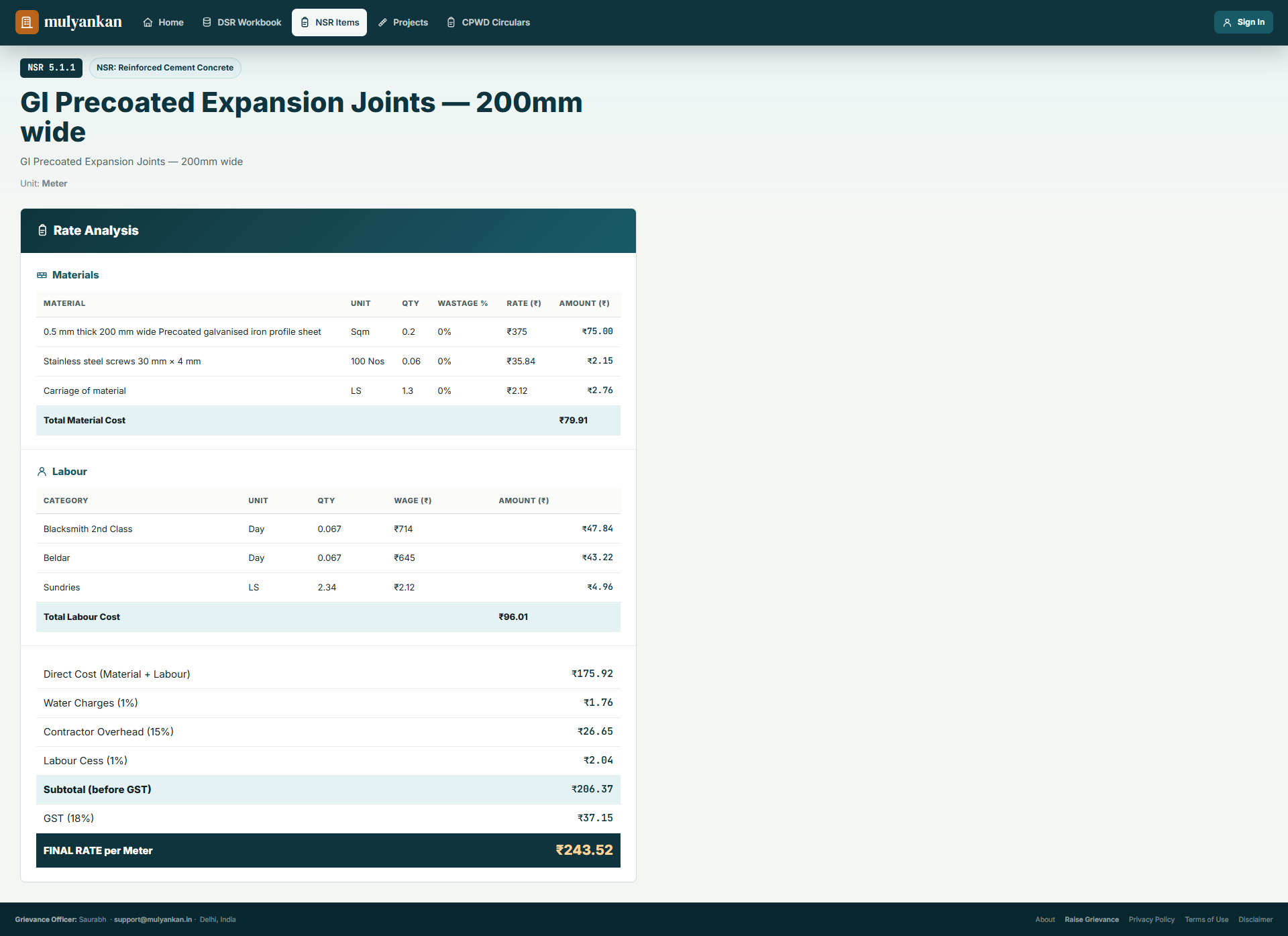
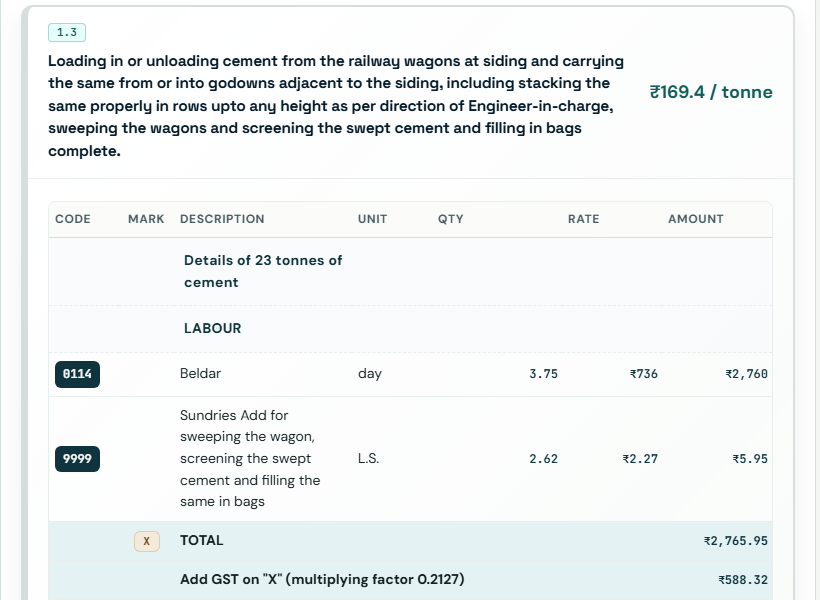
Here is what each looks like in the app — an NSR item with its computed rate, and a DSR item broken down into its full analysis of rates.
What is DSR (Delhi Schedule of Rates)?
The Delhi Schedule of Rates (DSR) is a standard list of pre-analysed rates published by the Central Public Works Department (CPWD). For each common item of work — excavation, concrete, brickwork, plaster, and so on — the DSR gives a ready unit rate along with its detailed Analysis of Rates (AoR): the material quantities, labour, and overheads that build up to that rate.
The current edition is DSR 2023 (formally the Delhi Analysis of Rates 2023). Its rates are based on the market prices of materials prevailing in Delhi during April 2023, it supersedes the 2021 edition, and it incorporates the prevailing 18% GST on works contracts. Labour rates in the DSR are taken from the minimum wages (basic + variable dearness allowance) notified by the Chief Labour Commissioner. A conventional 15% Contractor's Profit & Overheads (CPOH) is built into the analysed rates.
Because it is government-published and standardised, the DSR is the default basis for preparing estimates, tenders, and budgets for CPWD and most PWD projects.
What is NSR (Non-Schedule Rate)?
A Non-Schedule Rate (NSR) — also written as an NS item — is the rate for an item of work that is not listed in the DSR. New materials, proprietary products, special finishes, and unusual construction methods appear on site all the time, and no schedule can cover every possibility.
When an item isn't in the DSR, you build its rate from first principles: work out the material quantities and current market prices, add labour based on notified wages, then apply water charges, CPOH, cess, and GST — exactly the same components the DSR itself uses. This process is called NSR rate analysis, and it usually references DSR conventions (wastage, labour output, overhead percentages) so the result stays consistent with the rest of the estimate.
NSR vs DSR — the key differences
| Aspect | DSR (Delhi Schedule of Rates) | NSR (Non-Schedule Rate) |
|---|---|---|
| Coverage | Standard, commonly used items | Items not covered by the DSR |
| Source of rate | Pre-published by CPWD | Analysed by the engineer for the specific item |
| Basis of prices | Fixed market rates of the edition (April 2023) | Current market quotations |
| Standardisation | Government-approved, uniform | Custom, justified per item |
| Typical use | Bulk of the estimate / tender | Special or new items in the same estimate |
When do you use each?
In practice, a single estimate uses both. You take the DSR rate for every item that exists in the schedule, and you prepare an NSR analysis only for the handful of items the DSR doesn't cover. The NSR items are then attached to the estimate with supporting market-rate quotations for justification during tender scrutiny.
How the rate itself is built
Whether the item is from the DSR or an NSR, the unit rate is assembled the same way:
Item Rate = Material + Labour + Water charges + CPOH + Cess + GSTThis is why updating a single material price ripples through every dependent item — the same behaviour you get in a manual analysis, only instant. You can see this live in Mulyankan's tools below.
Try it free: browse ready DSR items or build your own NS item — no sign-up to explore.